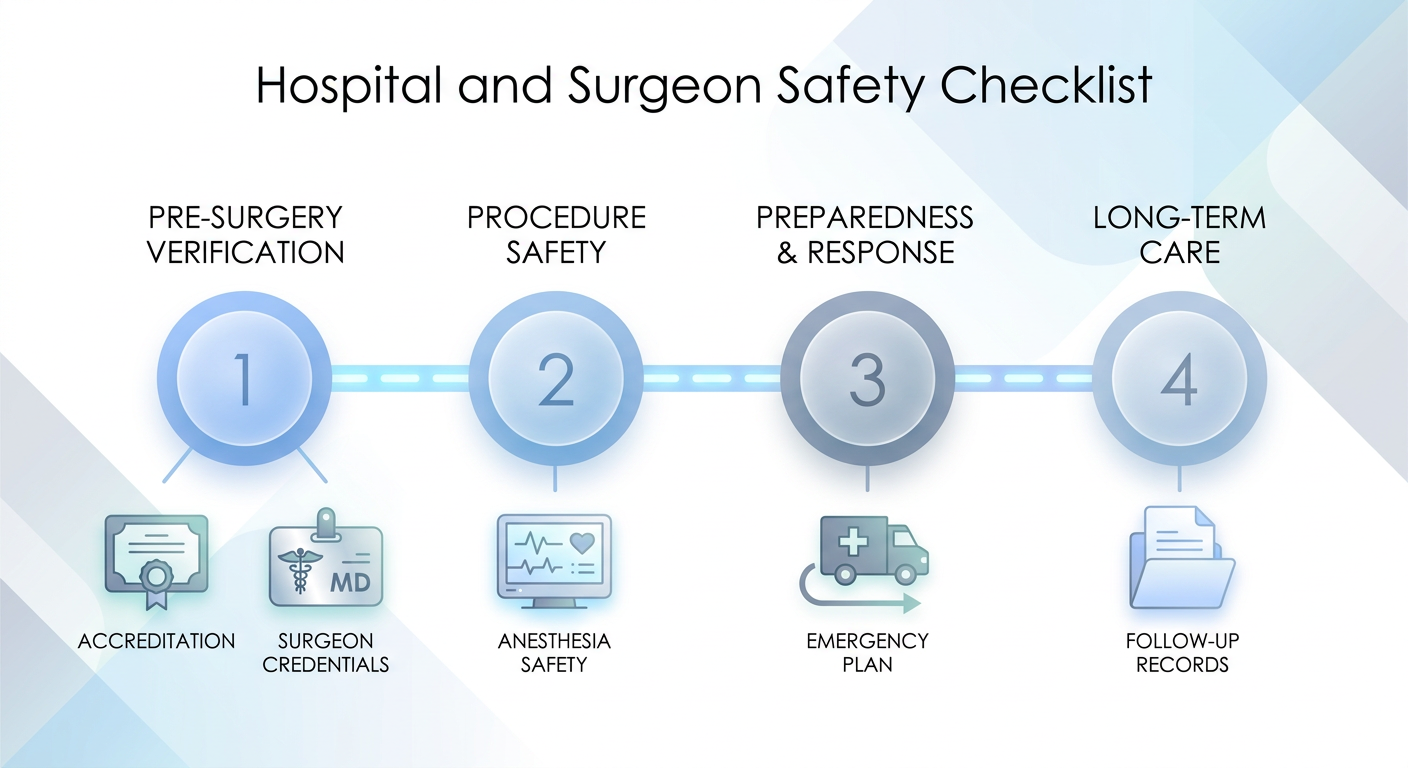
Questions to Ask About Hospital Accreditation and Surgeon Credentials in Mexico
Choosing a hospital or clinic in Mexico for bariatric or metabolic care can feel overwhelming—especially if you are comparing programs from the U.S. or Canada. Whether you are researching gastric sleeve surgery, gastric bypass, or endoscopic sleeve gastroplasty (ESG), safety should come before convenience, package pricing, or travel logistics.
This guide is educational and non-diagnostic. It is designed to help you prepare better questions about hospital accreditation, surgeon credentials, anesthesia safety, complication planning, and follow-up. It cannot tell you whether a specific facility or clinician is right for you. That decision should be made with a qualified medical professional who understands your health history.
Key Takeaways
- Accreditation is one safety signal, but it is not the only one. Ask what standards are used, who verifies them, and whether the accreditation is current.
- Surgeon credentials should include formal training, licensure, relevant bariatric/endoscopic experience, and a clear complication-management process.
- For medical travel, ask how emergencies, transfers, blood clots, language needs, and follow-up care are handled.
- A low quote should never replace careful review of safety systems, aftercare, and clinician qualifications.
- Individual results and recovery vary; use consultations to understand your personal risks and options.
Overview: Why Accreditation and Credentials Matter
Hospital accreditation and clinician credentials help patients evaluate whether a medical team follows recognized safety processes. In bariatric and metabolic care, these processes may include preoperative screening, infection prevention, anesthesia protocols, equipment standards, medication safety, emergency readiness, and structured follow-up.
For patients considering care in Mexico, accreditation questions are especially important because you may be far from your usual primary care doctor, specialist, or local emergency department. A reputable team should be willing to explain how the facility is regulated, what safety standards it follows, and how complications are managed if they occur.
Accreditation does not guarantee an outcome. A skilled surgeon and an accredited hospital can still have complications. However, transparent answers may help you compare programs more thoughtfully and avoid choosing based only on marketing claims or package price.
Understanding Bariatric and Metabolic Procedures
Bariatric and metabolic care includes several procedures with different risk profiles, recovery expectations, and follow-up needs:
- Gastric sleeve surgery: A surgical procedure that removes a portion of the stomach to create a smaller sleeve-shaped stomach.
- Gastric bypass: A surgical procedure that changes both stomach size and the way food travels through part of the small intestine.
- Endoscopic sleeve gastroplasty (ESG): A non-surgical endoscopic procedure in which sutures are placed inside the stomach to reduce its volume.
- Revision procedures: Follow-up procedures after a prior bariatric surgery, which may be more complex and require additional expertise.
Because these procedures differ, the questions you ask should be specific. For example, a hospital may be suitable for routine endoscopy but not equipped for higher-risk revisional bariatric surgery. A surgeon may be experienced in gastric sleeve surgery but not in ESG, or vice versa.
Who It May Be For
This article may be helpful if you are:
- Researching bariatric surgery or endoscopic weight-loss procedures in Mexico.
- Comparing hospitals, clinics, or medical tourism packages.
- Trying to understand what “accredited,” “certified,” or “board-certified” means in a cross-border care setting.
- Preparing for a consultation and want to ask better safety questions.
- Looking for ways to involve your U.S. or Canadian clinician in your planning.
Who Is Not a Candidate for Medical Travel Without Further Review
Some patients may need more extensive evaluation before considering medical travel for bariatric care. This does not mean they can never travel for care, but they should discuss risks carefully with qualified clinicians. Examples may include people with:
- Unstable heart or lung disease.
- A recent blood clot, stroke, heart attack, or major surgery.
- Poorly controlled diabetes, severe sleep apnea, or complex medication needs.
- Significant liver disease, kidney disease, or bleeding disorders.
- Active infection or untreated gastrointestinal disease.
- Pregnancy or plans for pregnancy soon after treatment.
- Limited ability to stay for follow-up or return quickly if a complication occurs.
Your candidacy depends on your full medical history, physical exam, testing, and the specific procedure being considered.
Realistic Benefits of Asking Better Safety Questions
Asking detailed questions will not eliminate risk, but it can help you:
- Identify programs that provide transparent information.
- Understand the qualifications of the surgeon, anesthesiologist, and support team.
- Confirm whether the facility can handle urgent complications.
- Prepare for travel, recovery, and follow-up more realistically.
- Avoid decisions based only on before-and-after photos, testimonials, or discounts.
Safety Considerations: Hospital Accreditation and Facility Standards
When you ask about hospital accreditation, listen for clear, verifiable answers—not vague statements. Helpful questions include:
- What accreditation or certification does the hospital currently hold? Ask for the accrediting organization, date, and renewal status.
- Is the facility licensed by Mexican health authorities? Ask how licensing can be verified.
- Is the procedure performed in a hospital or an outpatient clinic? Ask what level of monitoring and emergency capability is available.
- Are intensive care, blood bank services, imaging, and emergency surgery available onsite? If not, ask where patients are transferred.
- What infection-prevention protocols are used? Ask about sterilization, antibiotic protocols, and surgical-site infection tracking.
- How are complications tracked and reviewed? A safety-focused program should monitor outcomes and quality indicators.
- Is there a written emergency transfer agreement? If a higher level of care is needed, ask how transfer decisions are made and who coordinates them.
For endoscopic procedures such as ESG, ask whether the endoscopy suite is equipped for sedation monitoring, airway support, and urgent escalation. For surgical bariatric procedures, ask about operating room standards, anesthesia coverage, and postoperative monitoring.
Safety Considerations: Surgeon Credentials and Team Experience
Surgeon or endoscopist credentials should be more than a title on a website. Consider asking:
- Are you licensed to practice in Mexico, and in which specialty?
- What formal training did you complete in bariatric surgery or therapeutic endoscopy?
- Are you a member of recognized professional societies related to bariatric, metabolic, laparoscopic, or endoscopic care?
- How many procedures of this specific type have you performed?
- How do you select patients and decide who is not a good candidate?
- What is your process for managing leaks, bleeding, strictures, reflux, dehydration, or nutritional concerns?
- Who covers patient concerns after hours?
- Will I meet the surgeon or endoscopist before the procedure, not only a coordinator?
Also ask about the broader team. Bariatric and metabolic care is not only a procedure—it often involves anesthesia, nursing, nutrition, psychology or behavioral support, and long-term medical follow-up.
Procedure-Specific Risks to Discuss
Risks vary by procedure and patient health status. Ask your clinician to explain risks in plain language for your situation.
For gastric sleeve surgery, potential risks may include bleeding, infection, staple-line leak, reflux, narrowing, dehydration, nutritional deficiencies, blood clots, and need for additional procedures.
For gastric bypass, risks may include bleeding, infection, leak, bowel obstruction, ulcers, dumping symptoms, nutritional deficiencies, blood clots, and long-term need for vitamin monitoring.
For endoscopic sleeve gastroplasty, risks may include nausea, vomiting, pain, bleeding, infection, fluid collections, perforation, anesthesia-related problems, and the possibility of inadequate weight response or need for further treatment.
No program should promise a specific amount of weight loss or guarantee freedom from complications. Individual results vary.
Travel Planning for Care in Mexico
Medical travel adds practical safety considerations. Before booking, ask for a written plan that includes:
- English medical records: Request procedure notes, lab results, imaging, medication lists, discharge instructions, and implant or device details if applicable.
- Communication: Confirm who speaks English, who is available after hours, and how urgent symptoms are triaged.
- Companion planning: Many patients benefit from traveling with a responsible adult who can help during early recovery.
- Medication planning: Bring current prescriptions in original containers and confirm which medications should be paused or adjusted only under medical guidance.
- Blood-clot precautions: Long travel and surgery can increase clot risk. Ask about walking, hydration, compression devices or stockings, medication if appropriate, and when it is safe to fly or drive long distances.
- Return-home plan: Identify a local clinician willing to review records and support follow-up when you return.
Ask what symptoms should prompt urgent evaluation, such as chest pain, shortness of breath, fainting, fever, severe abdominal pain, persistent vomiting, black stools, calf swelling, or inability to keep fluids down.
Recovery and Follow-Up Timeline: What to Expect
Recovery timelines vary by procedure and individual health factors. In general:
- Before the procedure: Expect medical history review, lab work, nutrition instructions, medication review, and possibly cardiac, pulmonary, or sleep apnea assessment.
- First 24–72 hours: Monitoring focuses on pain control, hydration, nausea, walking, breathing exercises, and signs of early complications.
- First 1–2 weeks: Patients often follow a staged diet plan, prioritize fluids and protein as instructed, avoid strenuous activity, and watch for warning symptoms.
- Weeks 3–6: Many patients gradually increase activity and progress nutrition phases under clinician guidance.
- Long-term follow-up: Bariatric and metabolic care requires ongoing monitoring of nutrition, weight-related conditions, mental health, reflux symptoms, and lab values when applicable.
For surgical procedures, ask when you can safely travel home and what follow-up is required before departure. For ESG or other endoscopic procedures, ask how diet progression, symptom monitoring, and follow-up endoscopy or imaging decisions are handled.
Cost Context: Compare More Than Price
Costs for bariatric and endoscopic procedures in Mexico may be lower than self-pay prices in the U.S. or Canada, but ranges vary widely based on procedure type, hospital setting, surgeon experience, anesthesia, testing, medications, hotel, transportation, and follow-up.
A quote should clearly state what is included and what is not. Ask whether the price includes preoperative testing, hospital fees, anesthesia, surgeon fees, medications, nutrition support, complication care, extra nights, and follow-up visits. Be cautious about comparing programs only by the lowest advertised price; safety systems and aftercare matter.
Questions to Ask a Clinician: Safety Checklist
Bring this checklist to your consultation:
- What accreditation or licensing does the hospital have, and how can I verify it?
- Is my procedure performed in a hospital, ambulatory center, or endoscopy suite?
- What emergency services are onsite, and where would I be transferred if needed?
- What are your credentials and experience with this exact procedure?
- Who is the anesthesiologist, and what are their qualifications?
- What are the most common complications for my situation?
- How do you reduce the risk of blood clots, infection, leaks, bleeding, or dehydration?
- What testing do you require before deciding if I am a candidate?
- Who will monitor me after the procedure, and for how long?
- What English-language records will I receive before returning home?
- What follow-up is included, and who do I contact after hours?
- What costs are not included in the quoted package?
FAQ
Is hospital accreditation in Mexico the same as in the U.S. or Canada? Not necessarily. Accreditation systems differ by country and organization. Ask which body accredits the facility, what standards are reviewed, and whether the status is current and verifiable.
Does an accredited hospital guarantee a safe outcome? No. Accreditation can indicate that certain safety processes are in place, but it does not guarantee results or eliminate complications. Your personal risk depends on your health, procedure type, team experience, and follow-up.
What surgeon credentials should I look for? Ask about medical licensure, specialty training, bariatric or endoscopic experience, professional society involvement, and experience with the exact procedure you are considering. Also ask how complications are handled.
Should I ask for complication rates? Yes, but interpret them carefully. Ask how outcomes are tracked, over what time period, and for which procedures. Rates can vary depending on patient complexity and definitions used.
Is it safe to travel soon after bariatric surgery? Travel timing depends on the procedure and your condition. Ask your clinician when it is appropriate to fly or drive, how to reduce blood-clot risk, and what symptoms require urgent care.
What records should I bring home? Request English-language discharge instructions, operative or procedure report, medication list, lab results, imaging, diet plan, follow-up schedule, and emergency contact information.
Can my local doctor manage follow-up after surgery in Mexico? Some local clinicians may assist with follow-up, but it is best to arrange this before travel. Share your records and make sure there is a clear plan for labs, nutrition monitoring, and urgent concerns.
Next Steps
If you are considering bariatric surgery or endoscopic weight-loss treatment in Mexico, take time to verify the hospital, understand the clinician’s credentials, and review your personal risks with a qualified medical professional. A transparent program should welcome detailed safety questions and provide clear documentation.
To explore whether a procedure may be appropriate for you, you can request a private consultation with a qualified clinician and bring the checklist above to guide the conversation.
Medical Disclaimer
This article is for general educational purposes only and is not medical advice, diagnosis, or treatment. It does not replace consultation with a qualified physician, surgeon, endoscopist, dietitian, or other licensed healthcare professional. Individual results, risks, recovery, and candidacy vary. Always seek personalized medical guidance before making decisions about bariatric, metabolic, or endoscopic procedures.
Sources
- American Society for Metabolic and Bariatric Surgery (ASMBS): Patient learning resources and bariatric surgery information.
- International Federation for the Surgery of Obesity and Metabolic Disorders (IFSO): Global bariatric and metabolic surgery resources.
- Centers for Disease Control and Prevention (CDC): Medical tourism and travel health guidance.
- World Health Organization (WHO): Patient safety resources and surgical safety principles.
- Joint Commission International (JCI): International accreditation and patient safety standards overview.
- American Society for Gastrointestinal Endoscopy (ASGE): Endoscopy quality and safety resources.
Schema.org Recommendations
Consider adding the following structured data:
MedicalWebPagefor the article page.FAQPagefor the FAQ section.BreadcrumbListfor site navigation.Organizationfor the website or clinic entity, if applicable.PersonorPhysicianschema only for clinicians whose credentials are verified and kept current.